
ENG. / FR.


Future Aligned
A Platform for Partnership
2024/25 Annual Report
Our Vision
Bold Science for Brain Health
Our Mission
Accelerating, Amplifying and
Funding Brain Research Across
Canada

Naomi Azrieli, O.C., D. Phil.
Brain Canada Chair

Viviane Poupon, PhD
Brain Canada President & CEO
Our Year in Review
Common Bonds, Uncommon Impacts
April 1, 2024 – March 31, 2025
Inputs
$37.4M
invested in research
119
active partners
51
engagement events with stakeholders


Process
22
competitions launched
3
new programs launched
149
clinicians and researchers who took part in Brain Canada-led peer review panels
26
peer review panels held
Results
169
grants
awarded
9
Black scholars supported through a targeted partner program
484+
researchers supported
141
institutions supported
59%
proportion of projects w/ SGBA+ and/or EDI as a focus or consideration


Outputs
459
student,
trainees and
highly qualified
personnel engaged
25
active clinical trials supported
by Brain Canada
(and other funders)1
9,511
people accessing
Brain Canada-funded clinical
trials2
Outcomes
197
peer-reviewed
publications
resulting from
Brain Canada
funding
190,000+
citations of
Brain Canada-
funded
publications
(cumulative
since 2011)
7
patents, licences, intellectual property rights registrations, and spin-off companies resulting from Brain Canada funding

1, 2 as reported in the ClinicalTrials.gov database
Our Allied Approach
Connect, Convene, Converge
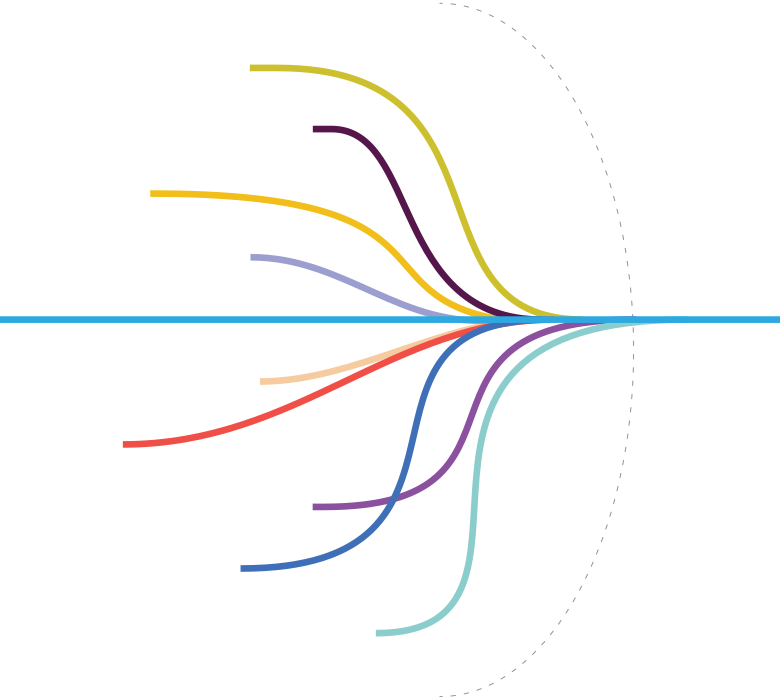
Brain Canada plays an important role in the brain research ecosystem, acting as a platform for partnership that convenes like-minded organizations and individuals who fund the bold research we need to improve brain health for all. Over its more than 25-year history, Brain Canada has successfully leveraged federal research funding to attract matching investments, significantly amplifying the impact of the government’s investment in brain research. This arrangement enabled a total investment of more than $400 million in brain research from 2011–2024.

Disease Associations
& Societies
Organizations
Working with
Indigenous
Peoples
Corporate
Research Institutions
& Networks
Foundations
& Donors
National &
International Funders
Provincial Health
Funders
Pharma
Stakeholders
Brain Research Ecosystem

Our Funded Research
Innovation Partners
Brain Canada’s innovation partners include individuals, private foundations, corporate donors and others who share Brain Canada’s vision for pushing the boundaries of knowledge about the brain. For example, Brain Canada’s Future Leaders in Canadian Brain Research program is made possible with an anchor gift from the Azrieli Foundation, with support from other major donors. Thanks to this collective generosity, Brain Canada has awarded 109 grants and invested over $10.9 million since 2019 in seed funding to early-career researchers, helping them pursue their bold ideas.
Decoding Depression and Anxiety
Sensitivity to ongoing stress is linked to higher levels of inflammation in the body and a weakened blood-brain barrier (BBB) that lets this inflammation enter the brain, according to research by Dr. Caroline Ménard (2020 Azrieli Future Leader in Canadian Brain Research) and her team. Stress resilience is connected to maintenance of brain barrier integrity, and this maintenance is facilitated by an increase in what are called CB1 receptors on astrocytes, star-shaped cells that line the BBB like a fence. Dr. Ménard hopes that these findings will inform the development of targeted therapies for depression and anxiety, to help the 30-50% of individuals for whom currently available treatments aren’t effective.

Health Charity Partners
Brain Canada’s commitment to advancing our understanding of the brain and identifying solutions to its diseases and disorders takes a targeted approach with health charity partners. Through these partnerships, we’re able to amplify funding aimed at specific diseases and disorders, from Alzheimer’s disease and ALS to brain cancer and stroke.
Trailblazing Alzheimer’s Findings
A research project led by Dr. Sylvain Baillet, funded via the Alzheimer’s Association International Research Grant Program in partnership with Brain Canada, generated new insights into early brain changes in Alzheimer’s disease. He and his team studied healthy older adults at risk for Alzheimer’s and found that early amyloid buildup in the brain is linked to increased brain activity. However, they found that when tau protein also builds up—especially in memory-related areas—brain activity slows down and early signs of cognitive decline appear. These findings, which mirror patterns seen in animal studies, help us better understand how Alzheimer’s develops before symptoms appear, bringing us closer to early detection and targeted treatments for Alzheimer’s disease.

Commercialization Partners
Brain Canada has a proven track record of successful collaboration with industry and academia to accelerate brain health innovations. For example, Brain Canada has partnered with the Quebec Consortium for Drug Discovery, CQDM, since 2014.
Taming Insomnia and Neuropathic Pain
Dr. Gabriella Gobbi’s CQDM and Brain Canada-funded research breakthrough could transform treatment for insomnia and neuropathic pain. The compound they discovered uniquely targets brain receptors that control circadian rhythms, promoting deep, restorative sleep while reducing chronic pain at lower doses. With 24% of Canadians suffering sleep disorders and limited neuropathic pain treatments available, this dual-action therapy addresses massive unmet medical needs. Dr. Gobbi and her team worked with academic and industry partners to transform the compound into a viable drug formulation, and are now looking ahead to first human trials.

Platform Partners
Platform Support Grant (PSG) recipients secure their own sponsors to match Brain Canada’s investments. These sponsors vary from academic institutions and research centres to foundations and corporations. Between 2014–25, Brain Canada has awarded 60 PSGs in partnership with over 80 unique sponsors, for a total investment of $162.5 million.
Breakthroughs in Suicide Prevention
The one-of-a-kind Douglas-Bell Canada Brain Bank, led by Dr. Gustavo Turecki (PSG 2014, 2019), houses more than 3,600 brains maintained in the best possible conditions for cutting-edge scientific research. It distributes more than 2,000 brain samples on an annual basis to dozens of researchers across Canada and around the world. It has enabled countless breakthroughs on everything from the effects of early-life adversity on the brain, to why disparities in depression rates and treatment efficacy differ between men and women. And according to the Overton Index, the world’s largest policy and grey literature database, one of the Brain Bank’s seminal publications has informed suicide prevention policy documents globally.

Our Journey
The Future Has Always Been Our Horizon
1998
Brain Canada is born, but under a different name: the NeuroScience Canada Partnership and Foundation
2001
Brain Repair Program is launched, with the goal of accelerating collaborative, multidisciplinary, multi-institutional brain repair research
2006
The Case for Canada’s Increased Investment in Brain Research reveals the total economic burden of brain disorders
2008
NeuroScience Canada rallies health charities to speak to the government about brain strategy with one voice
2010
The organization approaches the Government of Canada to form a partnership supporting brain research
2011
The name Brain Canada Foundation is established as well as the Canada Brain Research Fund (CBRF), a partnership with the Government of Canada to match $100M
2016 - 2021
The Government of Canada invests an additional $100M in CBRF
2024
Budget 2024 renews CBRF with a commitment of $80M
2025
Brain Canada continues to accelerate, amplify and fund brain research in Canada

Our Donors
Our Deepest Gratitude for
Your Selfless Support
We extend profound appreciation to our lead donors, whose caring, transformative contributions are driving research breakthroughs. Each collaboration sets a powerful example and plays a vital role in shaping the future of brain health, in Canada and beyond.
Donors for the period of April 1, 2024‑March 31, 2025
$100,000+ (Lead Donors)
- American Iron & Metal (AIM) /AIM Recyclage
- The Azrieli Foundation
- Bell Canada
- Hewitt Foundation
- Kacharie Foundation
- The Krembil Foundation
- The Erika Legacy Foundation
- Omico Investments Inc.
- Power Corporation of Canada
- RBC Foundation
- Alvin Segal Family Foundation
- Tavares Family Foundation
- Larry & Judy Tanenbaum Family Foundation
- Women’s Brain Health Initiative
$25,000–$99,999
- The Arrell Family Foundation
- Ken & Sharron Bowman Foundation
- Crabtree Foundation
- John & Mary Crocker
- GO LLP Chartered Professional Accountants
- Lotte & John Hecht Memorial Foundation
- Jane Inch
- Blair I. Levinsky
- The Catherine and Maxwell Meighen Foundation
- The Barbara Turnbull Foundation for Spinal Cord Research
- Wheeler Family Foundation
- The Arrell Family Foundation
- Ken & Sharron Bowman Foundation
- Crabtree Foundation
- John & Mary Crocker
- GO LLP Chartered Professional Accountants
- Lotte & John Hecht Memorial Foundation
- Jane Inch
- Blair I. Levinsky
- The Catherine and Maxwell Meighen Foundation
- The Barbara Turnbull Foundation for Spinal Cord Research
- Wheeler Family Foundation
$10,000–$24,999
- Bondi Produce & Specialty Foods
- M. Wayne and J. Coleman Family Fund
- Do It For Dementia
- London Drugs Foundation
- Toby Fouks
- The Henry and Berenice Kaufmann Foundation
- SHMP Holdings Ltd.
- The Mireille and Murray Steinberg Family Foundation
Our Financials
Strength in Numbers
Brain Canada Foundation's audited
financial statements, prepared by EY,
are available here.