
Are Lost Memories Really Gone?

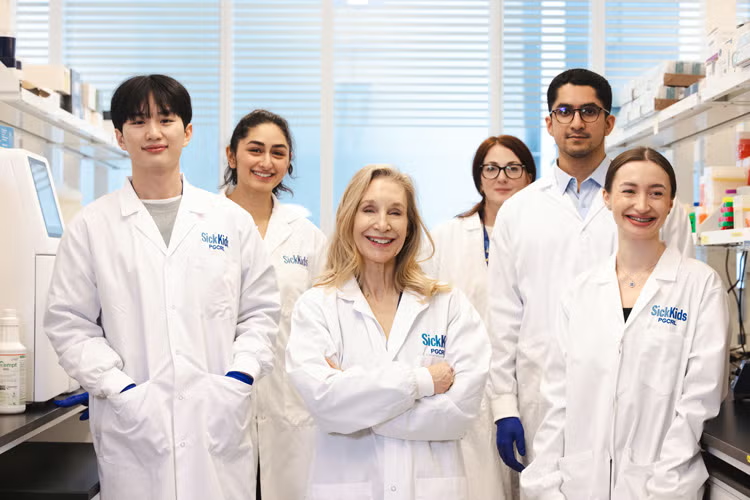
PHOTO: Sheena Josselyn with members of her team at the Hospital for Sick Children
Eternal Sunshine of the Spotless Mind. Total Recall. Inception. Memento.
Erasing memories. Implanting false ones. Bringing lost memories back.
It sounds like science fiction. In Sheena Josselyn, PhD’s lab, some of it is becoming science fact.
“We can erase a memory just like they do. We can implant a false memory. And we can have you recall a memory just like a real-life Total Recall,” Josselyn explains.
“To be clear – this is all in mice, and it’s hugely unethical to do this in people, but it’s amazing that we understand enough of the science to be able to bring the science fiction to life, at least in the lab.”
- Sheena Josselyn
But Josselyn isn’t manipulating memories simply to prove that it can be done. By learning how the brain stores and retrieves memories, her research is revealing tantalizing clues about what happens when that machinery begins to fail.
Finding a Way Back to Lost Memories
Josselyn’s work suggests something remarkable: at least in mouse models of early Alzheimer’s disease, some memories that appear to be lost may still exist in the brain – but become difficult to access. Josselyn’s team identified the group of neurons, or engram, that held a particular memory. Mice that could no longer recall the experience on their own were able to retrieve it when researchers directly reactivated those cells. The team also identified a molecular mechanism involved in switching these memory cells between accessible and inaccessible states.
“The principle is that the memory might not be gone entirely. It might just be that we can’t find the memories in our brains at some point.”
- Sheena Josselyn
Which begs the question: could some inaccessible memories in the early stages of Alzheimer’s disease still leave a trace in the brain, waiting for the right key? And could researchers develop therapies or smart drugs that unlock or strengthen these hidden memories?
“If we understand a little bit more the fundamentals of memory, we will get there,” Josselyn says. “It’s hard to envision exactly how, but there are really amazing people working on precisely this question – is there a way to unlock information, knowledge, memories in our brains?”
The work is incredibly timely. Around 750,000 Canadians currently live with dementia, including Alzheimer's, with numbers rising rapidly. By 2030, nearly 1 million Canadians could have dementia; by 2050, over 1.7 million. Dementia costs Canada billions annually in healthcare and out-of-pocket expenses, and by 2050 is projected to reach $2.4 trillion.
Anatomy of the Breakthrough
Brain Canada-supported research infrastructure gave Josselyn and her team the tools to identify the neurons holding a particular memory, watch what happened when mice tried to retrieve it, and precisely reactivate those cells. The experiments reinforced a fundamental principle of memory: the cues available when we try to remember something can help determine whether the brain finds the memory at all. Josselyn's team showed that the neurons activated during recall most closely resembled those activated during learning when the surrounding conditions also matched.
That principle takes on particular significance when memory retrieval begins to fail, and it also offers families a different way to think about supporting someone living with Alzheimer’s.
One of the cruel paradoxes of Alzheimer’s disease is that the ability to form and retrieve recent memories is often affected early, while some older, deeply rooted memories can remain accessible much longer. Someone may struggle to remember what happened that morning yet light up when they hear a song they loved decades earlier.
Practical Tips for Engaging a Loved One with Alzheimer’s Disease
Josselyn's research isn't suggesting that a song or photograph can restore memories lost to Alzheimer's disease. But it does underscore something important about how memory works: retrieval depends on cues. And that principle offers families a gentler way to create opportunities for memory and connection.
Play the soundtrack of their youth: Music from adolescence and early adulthood can be especially powerful. Build a playlist around songs they loved when they were young and make it personal by including music connected to important people, places and milestones.
Make it personal, and simple: Share uncluttered photographs of recognizable people and places, make a basic and familiar recipe, bring an object from a favourite hobby, or play music with a strong personal connection. A few meaningful cues may be easier to engage with than an entire album or collection.
Invite, don’t quiz: Instead of asking, “Who is this?” or “Do you remember where this was?”, try questions without a right or wrong answer: “What do you notice in this picture?” “What do you think that day felt like?” or “What did a kitchen like this smell like?”
Look for connection, not correct answers: A cue doesn’t have to produce a specific memory to be worthwhile. A smile, a tap of the foot, a moment of calm or a feeling of recognition can be meaningful forms of connection. If something causes frustration or distress, simply move on and try something else.
The Brain Behind the Breakthrough
“I like trying to figure things out, and to me, the brain and memory is the world’s biggest puzzle. It’s the hardest one out there, far more complex than any crossword, logic problem, or whodunit plot.”
- Sheena Josselyn
For her, trying to understand how memories are formed, stored, and lost is like working on a vast, intricate puzzle where every new piece can eventually help patients, not just satisfy curiosity. That blend of playful problem‑solving and high stakes is what keeps her in the lab.
Josselyn’s fascination with memory isn’t just intellectual – it’s deeply personal. Her mother developed dementia before she died, and Josselyn describes the experience as “gut-wrenching.” She watched someone she loved lose access to abilities and memories that had once seemed effortless. And alongside the grief, the scientist in her kept asking questions: What exactly was her mother forgetting? Why were some days better than others? What could those fluctuations reveal about how memory works?
That uneasy mix of grief and scientific curiosity now fuels her work: a determination to crack the code of memory not just because it’s the biggest puzzle she can imagine, but because better answers are desperately needed for patients and families and given our aging population – societies.
Josselyn knows that unlocking the biology of memory won't produce an Alzheimer's treatment overnight. But every discovery reveals another piece of the puzzle: how memories are written into the brain, how they become inaccessible, and — perhaps one day — how scientists might help bring them back.
Science fiction imagined a world where memories could be switched off and on. Josselyn is helping uncover the real biology that could one day make lost memories easier to find.
What We Can Do: What Memory Researchers Want You to Know
Josselyn stresses that our everyday memory is surprisingly resilient and powerful – she references research that tracked people’s daily activities with a tiny camera, taking photos automatically every 10 seconds over the course of multiple days. The results showed that people’s recall of everyday events was actually pretty good, not a hopeless blur of errors.
Still, Josselyn says there’s a lot we can do to help memory along and minimize forgetfulness.
Get sufficient, good quality sleep
During deep sleep, the brain actively replays the day’s memories, transferring them from the short-term storage of the hippocampus into the permanent, long-term storage of the cortex. Sleep is also increasingly recognized as important for brain health, with research linking sleep to the brain's systems for clearing metabolic waste.
“We know that certain memories replay, consolidate and strengthen when we sleep, making them more reliably retrievable,” explains Josselyn. “Sleep also clears things that we don’t really need to remember, so it’s super important.”
Prioritize single tasking
The way to maximize memory recall is to really encode that memory. And Josselyn asserts that these days we don’t do that very well, because we’re multitasking – we don’t remember where we put something down because we weren’t really paying attention. Josselyn stresses that if you want a memory to stick, do one thing at a time and pay full attention – otherwise you’ll have a harder time with recall because you’re trying to retrieve a memory that was never properly stored.
Release the pressure
The more pressure we put on ourselves to remember something – a name, a fact in a meeting, where you left your keys – the more you panic, and the harder it becomes for your brain to find that memory. This is true for kids, for adults, and especially for people already worried about their memory. She suggests taking the pressure off: pause, breathe, and change the context instead of mentally yelling “remember!” at yourself. Retracing your steps, adding gentle cues (where were you, what were you doing, who was there?), or shifting focus and coming back later all give your brain more ways to access the memory. Her bottom line is reassuring: forgetfulness is often normal, and being kinder to yourself — lowering the stakes and the self-criticism — actually makes it easier to remember.
Dr. Sheena Josselyn was awarded a Brain Canada Platform Support Grant in 2021 entitled SLAP-CAN In vivo Imaging Facility. She is a member of Brain Canada’s Research Committee, a Senior Scientist in the Neurosciences & Mental Health program at The Hospital for Sick Children in Toronto, and a Professor in the Departments of Psychology and Physiology at the University of Toronto.