
A future, Future Leader explores what it means to be a neuroscientist, on world stage

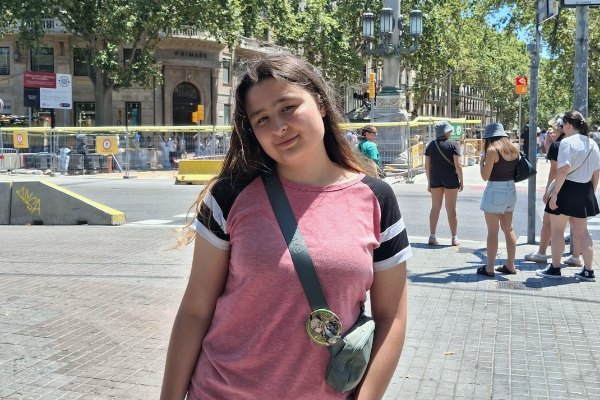
Canadian Brain Bee Champion Emma Rees travels to Spain and uncovers the key ingredient to a meaningful career in science - connection
By Emma Rees
There is a certain image of a neuroscientist that exists in our minds. It often looks like a lone person sitting in a dimly lit lab at midnight – meticulously examining brain slices under a microscope – while the manuscript for their next paper is anonymously reviewed halfway across the globe. Scientists are imagined as outstanding individuals, their discoveries the products of a single ingenious mind.
At least, that was the image that existed in my mind while I spent my spare time studying for the Brain Bee, a global neuroscience competition for high school students.
Science is often framed as a solitary endeavour, and for a long time, that’s exactly how I experienced it. Studying was almost entirely an individual pursuit, squeezed into the gaps of time between schoolwork and everyday life. I spent hours poring over textbooks, flashcards, and practice questions–and while I certainly enjoyed learning about the intricate world of molecular pathways and neurological disorders – I couldn’t help but wonder if this was all that science has to offer. I knew I loved to learn, but I wasn’t sure if I wanted the career I imagined would come with it.
It wasn’t until I attended the NextGen program, as one of the top five champions at the International Brain Bee, that I saw the other side of what neuroscience can be.
In July, I travelled from Ottawa to Barcelona to attend the FENS Forum, Europe's largest neuroscience conference. Suddenly, I was surrounded by the part of neuroscience that happens before it is written into the textbooks: a world in which each aspect of the nervous system is debated, questioned, tested, and retested. From thousand-person lectures on neurodegenerative diseases to smaller symposia devoted to specific neural circuits, I was immersed in an entirely unfamiliar – but exciting – world.
Yet while I marveled at research and technology I was only beginning to understand, the most meaningful part of my experience was far simpler: the four friends I made. I quickly bonded with my fellow International Brain Bee champions – not only over our shared curiosity for neuroscience, but also as teenagers figuring out our futures. Coming from the United States, Canada, Australia, Ukraine, and Iran, we each had different journeys to the Brain Bee and carried unique aspirations for how we hoped to contribute to the world. I realized that while I had always envisioned a future for myself in neuroscience laboratories and medical clinics, I had somehow left an essential part of that picture out: the people around me.
Once I began looking for it, I saw collaboration everywhere. It appeared in the mentorship between professors and students, in post-lecture discussions among lecturers, and in friendships between peers chasing the same breakthrough. I began to realize that the same collaboration I observed between people eventually grew to shape the research itself. I was especially struck by a lecture on the growing field of cancer neuroscience, an area that could only have been made possible through communication between the neuro-oncologists treating patients in clinics and the cancer researchers working in laboratories. While there was a story of immense individual effort behind each publication and lecture, that work does not exist in isolation: it becomes part of a larger network. I came to understand that while there are plenty of intelligent people in the world, no single person can know or be everything – and no one needs to.
If I had understood earlier that science does not mean relegating myself to a world of isolation, I would not have been so hesitant to imagine myself within it. Research can feel distant to young people like me. Too often, we encounter the products of science – in polished textbooks and refined research papers – without seeing the network of people behind them.
If we truly want to inspire the next generation, we must change how we frame what it means to be a scientist: not a lone genius working in isolation, but one person contributing to a collective effort.
Emma Rees is the CIHR 2025 Brain Bee Champion. In July, she traveled to Barcelona, Spain to participate in the International Brain Bee NextGen 2026 at the FENS Forum.