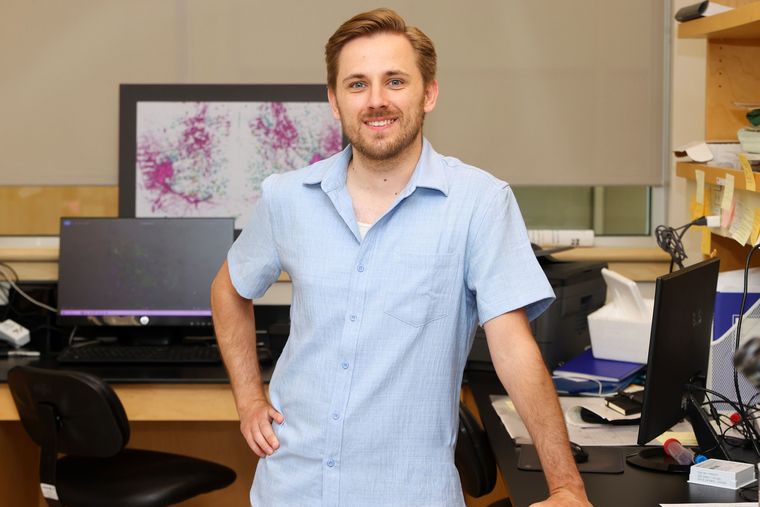
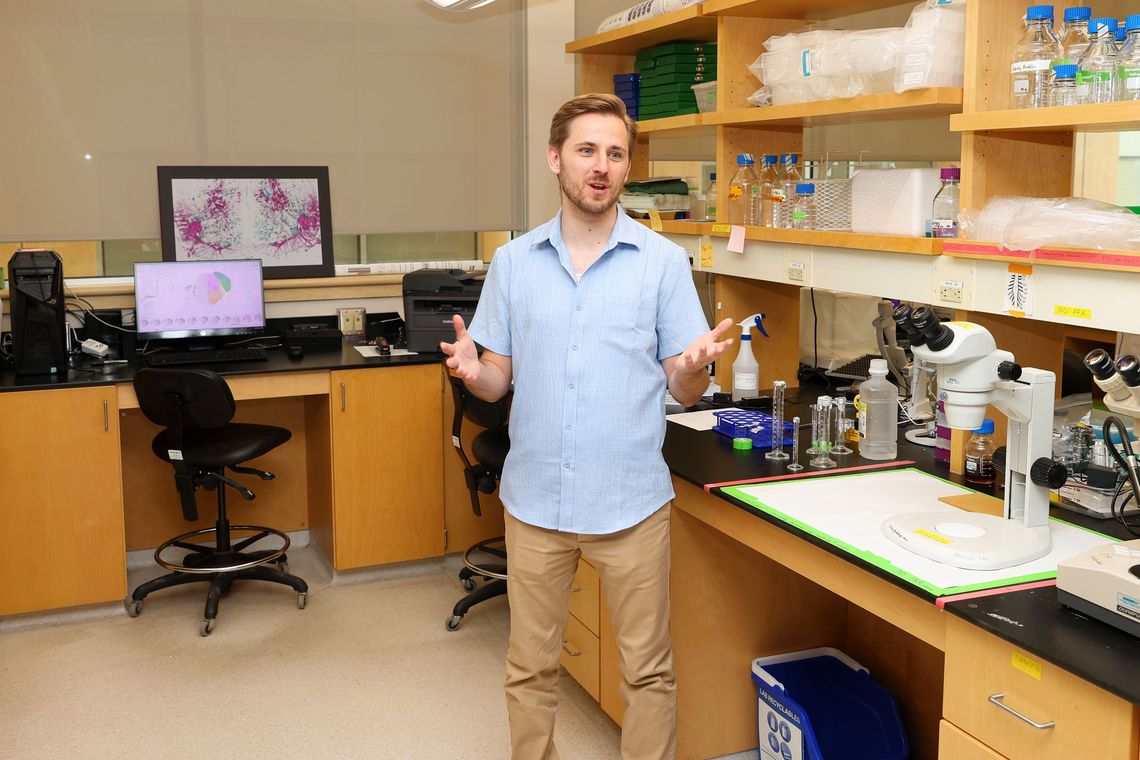
Currently in the fifth year of PhD studies at Dalhousie, Colin MacKay was recently awarded the Brain Canada Rising Star Trainee Award in ALS Research. His research probes a subset of cells in the spinal cord called V3 interneurons.
V3 interneurons, which appear to die off long before ALS symptoms emerge, are involved in movement, balance and coordination. By gaining new understanding of how these niche cells change over time, the hope is to predict the course of ALS and improve diagnosis and treatment.
“The ultimate dream would be some way to identify ALS a lot earlier because by the time symptoms appear the disease is actually quite advanced.”
- Colin MacKay
“In my mind, if research could find some way to freeze degeneration, find some way to halt the disease, and pair that with being able to identify ALS before people become incapacitated or before the disease reaches a tipping point, I think that would be fantastic.”
He also wishes that more young people realized the promise of neuroscience research and the potential of the field.
MacKay first became interested in studying ALS at the outset of his undergrad studies when the ALS Ice Bucket Challenge, a viral social media campaign, inspired him to co-found a student society on campus to raise awareness of rare diseases.
By the second year of his undergrad degree, he was volunteering in a lab studying spinal circuits at Dal. And his passion for research continued to grow.
Years later, MacKay remains committed to pursuing new directions and he’s thankful that Brain Canada support “provides me with the opportunity to dive deeper and probe some ideas that I’ve had for a long time around the earliest changes we can find in these V3 interneurons with respect to ALS,” he says. “I want to start work that can really make a difference.”
For a long time, ALS research looked mostly at motor neurons, the cells that directly control muscles. “Our lab is one of the few in the world that focuses on the V3.” The work, he hopes, will help unlock the big picture behind the disease.
Supervised by Dr. Ying Zhang, MacKay says the Brain Canada Rising Star funding program encourages skill development, builds confidence and promotes collaboration.
Asked what he would like to do after completing this PhD – “my Mom asks me that a lot,” he laughs – MacKay says he’s interested in roles in academia, the biotech industry and health policy.
“The biggest thing I want for ALS research in the next few years is to bring more hope for families. I want to see an effective treatment for a disease that is so hard on people and their loved ones.”
The 2025 Brain Canada Rising Stars Trainee Awards were made possible through the generous support of Linda Auger Morissette & Friends, in honour of Pierre Auger Morissette; Naomi Azrieli, François Blanc & Family, in memory of Madeleine Blanc; Allan Kliger & Family, who lovingly power the Olivier Goy Rising Star Trainee Award in ALS Research; Mireille & Murray Steinberg Family Foundation; Naomi Azrieli, in memory of Vivian Distler; M. Wayne and J. Coleman Family Fund; and the Seger-van Tol Family.
Meet the latest cohort of Rising Stars