Not No, Just Not Yet: A Huntington’s Disease Family’s Thank You

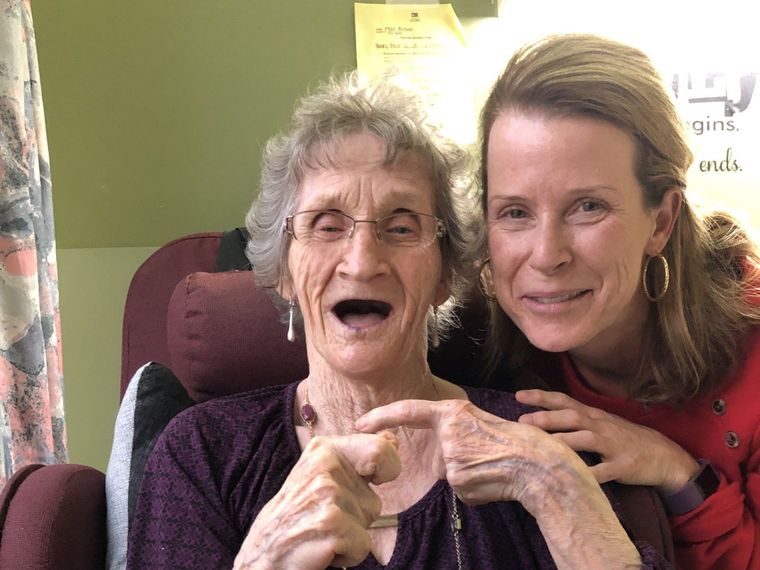
PHOTO: Corinne Brown and her mother, Mae Brown, who had Huntington’s disease.
Corinne Brown gave this speech on October 1, 2026, at the Centre for Brain Health at UBC, where Dr. Michael Hayden's team was celebrated for having recently received a Brain Canada Platform Support Grant to expand the HD Biobank, one of the world’s most important collections of human tissue samples for neurodegenerative disease research.
I am the author of Me, Mom & the Monster: Our Dance Through Huntington’s Disease. As a writer, it should come as no shock that I’m much more comfortable sitting in my corner writing than I am standing up here speaking.
But I’ve come to suspect that when Dr. Hayden calls and asks you to do something, you don’t say no.
To say being up here feeds my anxiety would be an understatement. Anxiety gives me a headache. But I am woman of opportunity and efficiency, so what better place to get a headache than here, at the Centre for Brain Health?
Why we say yes
Besides not wanting to say no to Dr. Hayden, there’s another reason I said yes.
I said yes because that’s what we do in the Huntington’s community. Every time something is asked of us, we say yes.
Yes, I can.
Yes, I will.
Yes, I’ll be there.
There are a few reasons for that, but from my perspective, the biggest one is this: the people who tirelessly work and advocate for research and advancement need to be able to count on us to be there, just as we count on them to continue their relentless pursuit of a treatment for a disease where one doesn’t currently exist. They’re all we have to help us forward.
We need each other.
There’s another reason for me. A personal one.
From the time my mother was diagnosed with HD until the time she died, 25 years passed. Nearly all my adult life. I need our experiences to count for something good.
In the later years of Huntington’s disease, my mother lost her ability to verbally communicate. So how could I pass up a chance to use my voice to educate, to raise awareness and, today, to say thank you?
Not no, just not yet
When my mom moved into the nursing home and I would visit her regularly, sometimes I would sit near her bed and tell her about the research being conducted and the findings of those research studies and clinical trials. While the news was not what we wanted to hear, we always knew it didn’t mean NO, it just meant NOT YET.
Thank you to the people who work at the Biobank here at UBC, and to Brain Canada.
Your funding and your relentless commitment to research matter to people like me and to families like mine who live with debilitating, neurodegenerative, fatal diseases like Huntington’s.
But, we don’t simply live with these diseases. We build our lives around them. We live despite them.
And your funding, your commitment, and your vision fuel something that families like mine desperately need: That’s hope.
Pushing back the corners
Living as part of a Huntington’s disease family can often feel like you are being backed into a corner. As the years pass and the disease progresses, the room becomes smaller. The corners become tighter. The options become fewer.
And as those corners continue to close in on us, the Biobank and organizations like Brain Canada help us push them back. You foster research. You fuel discovery. And you give families like mine something incredibly powerful to hold onto: hope.
As a person who lives at risk of Huntington’s disease, your work, your drive, your determination, and your belief in our community continue to offer me a glimmer of hope that things will be different not just for my generation, but certainly for the generations that come after me.
Hope was my lifeline in the dark abyss of Huntington’s disease.
And as a member of the HD community, I want to acknowledge the tremendous support and partnership of Brain Canada. I share in the enthusiasm for what is ahead, and I am deeply grateful for the Biobank and for the people who work there.
Thank you, from many families
Yesterday, I posted a video on social media that I was coming here today and how nervous I felt about it but, I felt it was part of my responsibility as part of a Huntington’s disease family to share my story. I was completely overwhelmed with responses, some from people I knew and some that I didn’t who all said, “Please say thanks on behalf of my family, on behalf of my mom, my dad, my brother, my sister.” The work you are doing is impacting people.
Thank you for believing.
For helping.
For advancing.
For educating.
For advocating.
For fostering discovery.
For fueling hope at a time when our community needs it more than ever.
Most of all, for staying persistent in the quest for a treatment.
The next chapter
I wrote my book to raise awareness of what living with a neurodegenerative, fatal disease looks like from a patient and family perspective.
I didn’t start to write a book. I just started scribbling a few words that turned into sentences, paragraphs and eventually chapters. Wow, I thought, I think I have a book.
I needed to share that lived experience. I needed what our family went through to count for something.
Turns out, I had a lot to say.
Turns out, people are buying, reading and listening.
But I know there will come a day when the story needs another chapter.
The next edition of my book will include a chapter about the day we found a treatment for Huntington’s disease.
And with the work of the extraordinary people who work at the Biobank and the support of Brain Canada, I hope you’ll help me rewrite history.
One day soon.
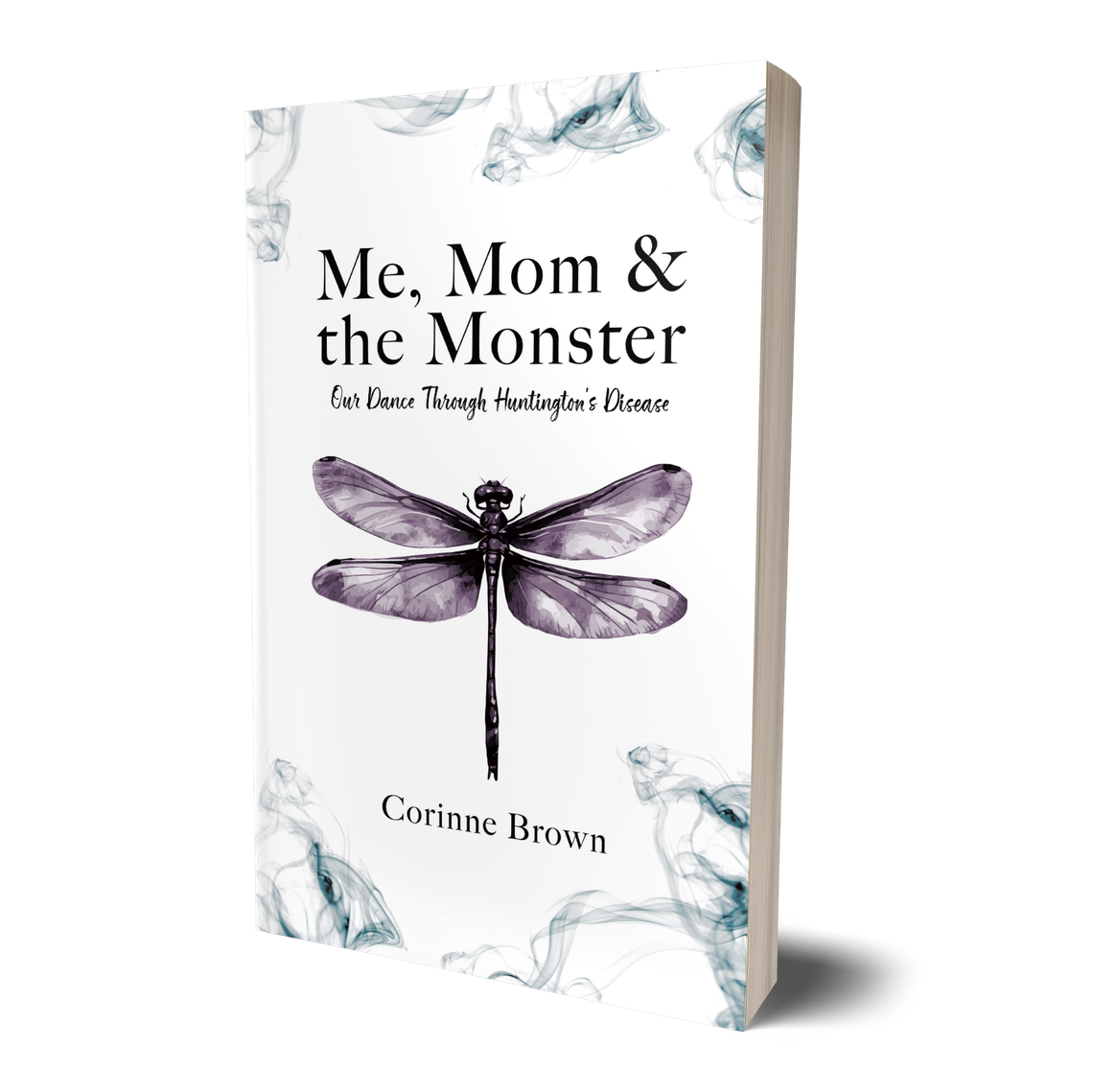
Follow Corinne at corinnebrown.ca, on Instagram and on Facebook.
Corinne is donating all book royalties to research for Huntington’s Disease.
Funding acknowledgement:
The HD Biobank is supported by Brain Canada through the Canada Brain Research Fund (CBRF), an innovative partnership between the Government of Canada (through Health Canada) and Brain Canada Foundation, with financial contributions from Health Canada, national and regional partners, and donors.