
Finding Words Again

How research is helping stroke survivors reclaim their voice
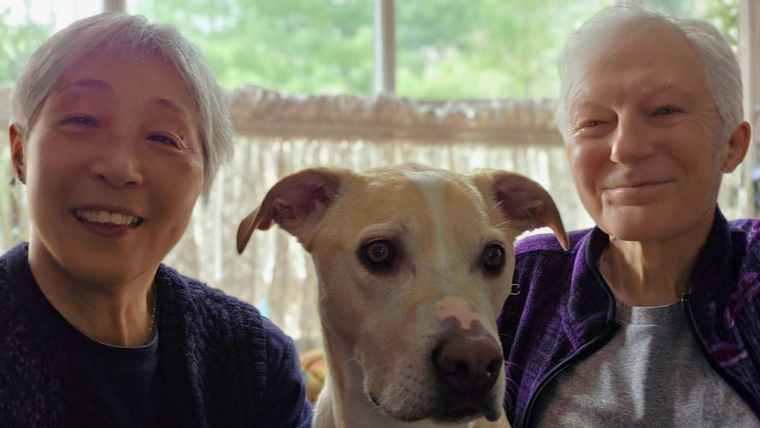
On a quiet morning in October 2020, John stepped outside of his home to feed the birds. It was the kind of simple ritual that anchored his routine as a tenured Sociology professor focused on animal rights and compassionate living. Then, without warning, the world tilted. He fell. He tried to stand up and couldn't understand why his body wouldn't cooperate. It passed and back inside, he began spilling coffee beans, watching them scatter without knowing what was happening.
His wife Atsuko called an ambulance. By the time John reached the hospital, he had lost consciousness entirely. When he woke, he could barely walk. And the words, that had been so instrumental to him as a scholar and teacher, were suddenly gone.
John learned he had suffered a stroke. And like roughly 30 percent of the estimated 100,000 Canadians who survive one each year, he was left with aphasia: a condition that fractures the bridge between thought and language.
A stroke occurs in Canada every seven minutes, and the survivors who develop aphasia often describe it as one of the most devastating losses imaginable.
The ideas are still there. The person is still entirely present. But the words slip and stall, arriving wrong or not at all. Someone reaching for the word cup might say glass, or pup, or nothing.
The isolation that followed was profound. COVID protocols meant Atsuko could visit only once a day, briefly, and phone calls were nearly impossible.
"Aphasia changed my life completely," John says. "I had to struggle to say yes or no and I continue to struggle to say things and overcome this condition. It's very frustrating. But I am trying my best."
Since leaving the hospital, John adhered to a demanding recovery schedule: physiotherapy, occupational therapy, speech and language therapy, an aphasia support group, and daily exercises at home. He continues these rehabilitation efforts today.
He has also found something unexpected along the way: a research study led by Dr. Tijana Simic, a Brain Canada Future Leader in Canadian Brain Research. With the seed funding that Dr. Simic received from Brain Canada and CIHR’s Institute of Aging, she and her team at University of Toronto are investigating the precise mechanisms behind aphasia therapy and how to make it work better for each individual.
They are focusing on two types of cueing strategies used in word-finding therapy: meaning-based cues (you pour coffee into it) and sound-based cues (it rhymes with pup). Using computational modelling to analyze speech errors before and after therapy, the research aims to identify which approaches work, for whom, and why.
“The progress we’ve seen with individuals like John is very encouraging and speaks to the brain’s remarkable capacity for recovery when the right interventions are in place. But, for every story like this, there are countless others still waiting. The work ahead is significant, and we’re only at the beginning of what’s possible.”
– Dr. Tijana Simic
For John, participating in this research has been more than practical. It has been restorative.
Atsuko has watched the change closely. "We didn't have a deep understanding of aphasia until we started working with Dr. Simic," she says. "Beyond dramatically improving his ability to speak in such a short period of time, it's been very informative and empowering.”
John and Atsuko are candid about what they wish would have been different: a more individualized approach during John’s hospital stay, care shaped specifically to who he was and what he needed. An observation that speaks to something at the heart of Dr. Simic's work and the recognition that aphasia is not one single experience, and recovery cannot be one-size-fits-all.
"This research is really important and worth supporting," he says. "It gave me back my confidence to speak."
For the thousands of Canadians who lose their words to stroke each year, research like this is the path back to connection, identity, and being heard again.